


Signs of Depression
Starting with the signs of depression, the Learning Path will take you on a journey during which you will learn astounding, revolutionary and vital facts about clinical depression. The aim is to give you up-to-date information on depression and what the research says is the best treatment. As you go along, follow the signs at the bottom of each page.
During your journey, you will learn:
- How therapists are now lifting even severe depression quickly.
- The astounding new discovery that shows how clinical depression is caused by over-dreaming, and what you can do about it.
- Why depression is 10 times more common in those born since 1945 than in those born before, and why this is important to you.
- The facts about drugs vs. therapy for clinical depression and much, much more.
Once you have completed the Learning Path, you will know enough about depression to decide on the best way for you to get rid of it, and stop it coming back. So, onto the first section...the signs of depression.
Have I Got Signs of Depression?
If you have been feeling down, or out-of-sorts, your thoughts can easily turn to whether you are depressed or not. This first section will take you through the signs of depression and how depression is diagnosed.
However, whether you 'fit' the depression diagnosis or not is unimportant. If you are feeling so down that you need to do something about it, that is enough.
Usually, our clients report one or more of the following:
- Exhaustion on waking
- Disrupted sleep, sometimes through upsetting dreams
- Early morning waking and difficulty getting back to sleep
- Doing less of what they used to enjoy
- Difficulty concentrating during the day
- Improved energy as the day goes on
- Anxious worrying and intrusive upsetting thoughts
- Becoming emotional or upset for no particular reason
- Shortness of temper, or irritability
Not all people have all of these, and some have different signs, but if you are depressed, at least some of these will probably ring true with you.
The individual signs of depression - the way you feel - are what are used in diagnosing depression. So it's easy to see why there is so much confusion, seeing as the signs are generally common emotions and feelings.
There are also physical effects of depression, which we'll come to later.
Only a qualified doctor or health practitioner can formally diagnose you with clinical depression. However, how they reach this diagnosis gives an incredibly important insight into how to treat depression.
Depression screening and tests for depression undiagnosed.
So let's look now at how clinical depression is normally diagnosed.
(Here is a list of online depression tests if you want to use one of them.)
Diagnosing depression
According to the definitions of most medical, psychological and psychiatric bodies, there is a commonality in the diagnosis of depression. Most depression tests have a very similar framework. Almost without exception, clinical depression will be diagnosed if a certain number of feelings, that are signs of depression, are present over a certain period of time.
Below is the 'official' guide for diagnosing clinical depression:
A person can be diagnosed as suffering from clinical depression if:
(A) Five (or more) of the following symptoms have been present during the same 2-week period and represent a change from previous functioning; at least one of the symptoms is either (1) depressed mood or (2) loss of interest or pleasure.
(1) depressed mood most of the day, nearly every day, as indicated by either subjective report (e.g., feels sad or empty) or observation made by others (e.g., appears tearful). Note: In children and adolescents, can be irritable mood.
(2) markedly diminished interest or pleasure in all, or almost all, activities most of the day, nearly every day (as indicated by either subjective account or observation made by others)
(3) significant weight loss when not dieting or weight gain (e.g., a change of more than 5% of body weight in a month), or decrease or increase in appetite nearly every day. Note: In children, consider failure to make expected weight gains.
(4) insomnia or hypersomnia nearly every day
(5) psychomotor agitation or retardation nearly every day (observable by others, not merely subjective feelings of restlessness or being slowed down)
(6) fatigue or loss of energy nearly every day
(7) feelings of worthlessness or excessive or inappropriate guilt (which may be delusional) nearly every day (not merely self-reproach or guilt about being sick)
(8) diminished ability to think or concentrate, or indecisiveness, nearly every day (either by subjective account or as observed by others)
(9) recurrent thoughts of death (not just fear of dying), recurrent suicidal ideation without a specific plan, or a suicide attempt or a specific plan for committing suicide
(B) The symptoms do not meet criteria for a Mixed Episode.
(C) The symptoms cause clinically significant distress or impairment in social, occupational, or other important areas of functioning.
(D) The symptoms are not due to the direct physiological effects of a substance (e.g., a drug of abuse, a medication) or a general medical condition (e.g., hypothyroidism).
(E) The symptoms are not better accounted for by Bereavement, i.e., after the loss of a loved one, the symptoms persist for longer than 2 months or are characterised by marked functional impairment, morbid preoccupation with worthlessness, suicidal ideation, psychotic symptoms, or psychomotor retardation.
OK, so that's what the doctors use. But if we look at E), it raises some interesting questions.
It says that clinical depression can be diagnosed if the symptoms cannot be attributed to bereavement. So, since grieving is a natural response, we can see that depression is simply an out-of-place natural response.
And of course it is. If it were not, we would have to take drugs to create it.
So what about the incredibly popular idea that depression is due to some unnatural chemical imbalance in the brain. That this 'imbalance' is the source and root cause of depression?
It's possible, but it just doesn't make sense for the majority of cases. And when we look at the increase in depression over the last 50 years or so, we will see that our brain chemistry just can't change that quickly.
Most depression is not due to a chemical imbalance, or genetic factors. Low serotonin levels are a result, not a cause, of depression.
Despite the prevailing ideas for the last few decades, this is now known to be a fact. (1)
This misunderstanding is also the reason why drugs for depression miss the point, and treat the symptoms instead of the causes.
Le Fanu. J. (1999) The Rise and Fall of Modern Medicine. Little, Brown & Company.
Understanding this is one of the keys to understanding depression itself.
Next article: Symptoms of Depression
Now that you know about the external signs of depression, next we'll look at depression symptoms and how they come about...
About the authors


The Depression Recovery Program
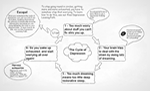
The Cycle of Depression
Understand precisely how depression makes you feel so bad, and what you can do to fight back today.


