


Controlling Depression with Antidepressants
ANTIDEPRESSANTS have been shown to be effective for some people in controlling depression, or at least episodes of depression, but are they a cure for depression?
Looking at how they affect depression, or at least depressive symptoms, is important when considering ways of actually beating rather than just controlling depression in the long term.
| In thousands of research studies, the treatment of depression with antidepressants alone has been found to produce the highest rate of relapse, compared to what are considered effective therapies in the treatment of depression. |
Since we now understand how antidepressants work in controlling depression (from the depression medication section of the Depression Learning Path), the reason for this high rate of relapse seems fairly obvious.
Depression medication and relapse
As we've shown from all tests and diagnoses, depression is shown to be about thinking styles, and the patterns formed by these styles. One of the symptoms that show these patterns have been set up and maintained is the reduced activity of specific neurotransmitters.
It is this reduction in activity that is treated by antidepressants, not the thinking patterns that caused them.
While on the medication, the effects of the depression may well be diminished, or even vanish completely. But what do antidepressants do to prevent relapse?
|
A clarifying metaphor for depression
A ship, sailing in calm waters, is going along nicely with a following wind. The crew, who know they lack some of the more tricky skills of dealing with bad weather, are perfectly happy in such good conditions. But then a storm blows up. The crew don't know what to do and so sail right into the middle of the storm. Once in it, they lose their way, not knowing how to set a proper bearing and stick to it. They go round and round within the storm, getting sicker and sicker, and the ship getting more and more battered. They try to do what they know but nothing seems to work, and after a while they become so exhausted they stop trying. Eventually, the storm dies down and calm returns. After a time, the crew recover, and sail the ship onward, albeit in its slightly worn state. They realise that if another storm comes along, they are going to be in the same position again, and so decide to put into the nearest port to learn the skills of coping with bad weather. So the crew above (the depressed person) realise they don't know how (haven't learnt the skills) to take a ship through a storm (a life crisis, or difficult situation.) Once in the storm (the depression), they don't know how to set a proper bearing (get themselves out of depression.) Once storm abates (life circumstances change), they decide to learn the necessary skills (balanced thinking styles, meeting basic needs etc.) What the equivalent of them using drugs would be - who knows? Pouring oil on the sea? |
So why don't people talk about curing depression, rather than controlling it?
Mainly because much of the debate on depression is fuelled by the drug industry, and it is well known that drugs do not cure depression. They control the symptoms. A true cure for depression is to learn the skills, habits and thought patterns of people who don't get depressed.
Other areas of treatment for depression have been shown to be highly successful, with a much smaller proportion of patients relapsing than with depression medication. Using the analogy above it is easy to see why.
"Curing depression" with drug treatment
Without repeating what we said earlier, it is unrealistic to expect drugs to be successful in curing depression when all they do is affect the symptoms - namely levels of neurotransmitters and amounts of REM sleep.
If you have completed the Learning Path this far, you will know the causes of these symptoms and will be able to see how the right approach has a much better chance of curing depression by getting to the 'root' of the problem.
Why do so many people have to change medication?
The use of antidepressants as depression medication is based on artificially increasing the amount of neurotransmitters found in the synaptic cleft, the area between two synapses. Neurotransmitters act as communication agents between the synapses.
But the body adapts to this "intrusive" addition to what is a very complex and delicately balanced system and so the medication becomes less effective. This accounts for why so many people on antidepressants often have to increase dosages, change types of medication etc.
It also explains why the effects of suddenly stopping medication can be fairly extreme.
|
IMPORTANT If you wish to cease taking antidepressant medication, see your medical practitioner first. Do not stop taking antidepressants without consulting a professional. If your doctor wants to change your antidepressant medication because you have become more depressed, ask him or her to think again. When your existing medication is ceased, it takes up to 6 weeks for the new medication to kick in. In the meantime, you may find yourself feeling even worse. |
While the chemical changes in the brain due to depressive episodes are temporary, (when the depression lifts the chemical activity, if different at all, goes back to normal), the effects of longer term use of antidepressants can be much longer lasting.
Prolonged use of depression medication has been shown to cause permanent physical changes to the brain's receptors, sometimes resulting in serious long term problems. Often associated with multiple medication, seratonergic syndrome is a neurological condition which results in fevers, seizures and heart rhythm disturbances.
What prevents depression coming back
When talking about curing depression, we are not simply assessing what will get rid of it, we need to look at what will stop it coming back.
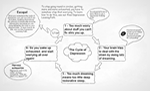
As we have seen, depression works through the type of cyclical thinking patterns that work on a "downward" spiral. (See the Cycle of Depression). It fuels our negative bias of events, reducing our apparent options, changing our behavior and affecting our sense of control.
What prevents relapse is the sufferer possessing the skills to deal effectively with life experiences, and perceiving these experiences in non-depressing ways.
This doesn't mean being unrealistic. It means being able to assess situations, our own feelings and our sense of control realistically. This is precisely what effective therapies such as cognitive and behavioral therapy do.
Positive life experiences increase levels of serotonin just as antidepressants do. Negative introspection reduces serotonin levels.
Curing depression is more about the sufferer learning a set of skills that innoculate them against further bouts of depression, rather than a 'magic bullet'.
Next article: Side Effects of Antidepressants
If you taking, or considering taking depression medication, you should be aware of the possible side effects of anti-depressants...
Interesting Article: Antidepressants vs placebos - Prozac or Placebo?
About the authors


The Depression Recovery Program
The Cycle of Depression
Understand precisely how depression makes you feel so bad, and what you can do to fight back today.


