


Depression and Your Sense of Control
BEFORE we move on to how to break the cycle of depression, we're going to go a little deeper into how your sense of control affects depression, which we touched upon in the last stage of the Depression Learning Path.It is common for depressed people to feel helpless, with little control over things. Or, alternatively, to feel that everything relies on them.
This extreme perception of control, either too much or too little, helps maintain depression in the following way.
- Too little control - the person stops doing things that could improve their situation, perhaps ceasing activities they used to enjoy.
- Too much control - person tried to control things they can't and may become angry or anxious when they realize things aren't happening the way they wanted. They may also take responsibility for things outside their control. This adds to the emotional arousal that maintains depression.
'Learned helplessness',or feeling trapped
A common feeling that accompanies depression is that of being trapped in an intolerable situation. The depressed person can often see two alternatives, neither of which is possible, and without change the existing situation is too painful. (More on this in 'All or nothing' thinking, next in the Learning Path)
Depression causes this illusion.
All too often, this feeling leads to suicide as the depressed person feels that their situation is insoluble by themselves or others.
In almost every situation, there is (at least one) acceptable alternative. Sadly, depression rarely lets people see it. This is why help from a correctly trained professional can be invaluable. They will be aware of the common thought patterns you may be experiencing, and have experience in helping you break out of them. (We will look at how to choose a therapist or counselor later in the Learning Path.)
A nasty rat experiment
Rats, like people, can be 'trained' to feel and behave helplessly.
In one famous experiment, rats were held down in ice-cold water until they stopped struggling. This taught them, through experience, that effort was futile and that nothing they did made any difference.
Then, 2 groups of rats, the second being a group which had not undergone this experience, were left in cold water without being held.
The group which had previously been held began to drown, on average, much, much sooner than the 2nd group of rats.
Some of the 2nd group, which had not been held immobile, actually managed to escape!
Our depressive rats were behaving as if they were still helpless even when they were not.
This experiment has been repeated in many ways, some on humans.
THROUGH experience, you can think, feel and behave as if you are helpless in a situation, when in fact you are not. The very nature of this often means that you cannot find your own way out, and need outside help to do so.
Learned helplessness in everyday life
So how does this happen in everyday life? Well, perhaps after several bad relationships, you may get the feeling that 'no matter what I do I'll never be in the right relationship'.
Or someone whose parents divorce may develop the feeling that 'I'll always lose any people I become attached to!' Being abused by a partner may lead you to imagine that you have no control in relationships generally.
Learned helplessness is exactly that - learned. Life experiences can cause 'learned helplessness' - by reducing your feeling of control as well as your available options in a situation, it can further add to the depression.
But because it is learned, this means we can learn to challenge it. New skills can break this pattern.
We can then, often with a good therapist, increase our number of total available responses in a given situation, and so increase our feeling of control.
Control: if not on the outside, then on the inside
Remarkably, people can have very little external control but not become depressed because they feel they have some kind of internal control.
Some research done on survivors of imprisonment and torture in South American regimes showed incredible results. It would be fair to say that these people had almost no control over their situation. Yet, in psychological terms, startling differences were found in the effects on the survivors.
The ones who were least traumatized and who had not become depressed during or after their captivity were the ones who had maintained a feeling of control even during torture.
When questioned they reported that they did this, for example, by screaming after counting to ten in their head before doing so. Or that they knew they would give information but would only give it at a certain time of day. They had little outside control but still maintained an internal sense of control.
It is this sense of control, which is so important. We may find ourselves in a situation where we have little control - such as waiting for the result of a medical examination, or waiting to learn whether someone still wants to be our lover. What can we do?
The only control we have during these situations has to be internal. By exercising control over different aspects, such as how or when we will react, we can retain a sense of control.
We can learn to tolerate uncertainty and 'be cool' without knowing the result of something for a while, in the meantime managing our emotional response.
The illusion of too much control
The other end of the spectrum from 'Learned Helplessness' is taking responsibility for things over which you actually have very little, or no control. Which, as you would imagine, can lead to major problems!
On being a rain god
Take the real-life example of a depressed woman who felt guilty over a picnic that she had organized being ruined by unexpected rain.
The depressed woman somehow blamed herself for the fact that the picnic had been rained out, despite the following facts:
- The forecast had said it would be fine.
- Her friends had still appeared to have fun under a big tent in the park.
All this was filtered out by the depressive thinking styles we looked at in the last part of the Depression Learning Path. She continued to see this event as evidence that she was a 'walking disaster area'.
Depression can make us ignore evidence which 'doesn't fit' with the depressive focus of mind.
All things to all people
Trying to be 'all things to all people' is a non-workable strategy.
Nobody can exert so much control so that everyone likes them. We need to be aware of how much or little control we assume we have over different areas of our lives.
It's less depressive (and more realistic) to realize that in some situations you do have control but only up to a point.
When a depressed person begins to generate alternative reasons for why things happen (or at least alternative possibilities) then the depression begins to lift. Depression requires a narrow, set focus to maintain itself, and these alternative reasons make that diminish.
Now we'll take a look at 'All or Nothing', or 'Black and White' thinking, something that almost all depressed people will recognize...
Next article: All or Nothing’, or ‘Black and White’ Thinking and Depression
About the authors


The Depression Recovery Program
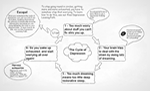
The Cycle of Depression
Understand precisely how depression makes you feel so bad, and what you can do to fight back today.


