


How Depression Causes Negative 'Spin'
"Nothing is good or bad but thinking makes it so." William Shakespeare
To understand clinical depression, it is essential to understand that people don't reflect reality (events, other peoples' comments etc.) so much as interpret it.
The same event can have completely different meanings to different people, even if their circumstances are the same.
Depression is partly maintained by how we interpret reality. The 'spin' we put on things. Knowledge about how this happens can turn lives around.
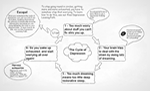
Remember from the cycle of depression that too many negative, emotionally arousing introspections lead to over-dreaming, which leads to exhaustion and depression.
So, to recap, events don't have any intrinsic 'meaning' until human beings add it.
Say a tree falls over in the forest, and no-one is there. It has no meaning whatsoever. Then along comes a walker, looks at the tree and thinks, "What a shame, such a beautiful old tree blown down in a moment." (Meaning=sad!)
At the same time a nearby householder looks out of his window and thinks, "What a piece of luck! That tree has blown down and the view is absolutely fantastic now."
A local beetle considers it great luck because he and his family now have somewhere to live for the next 29 generations! (Meaning=happy!)
In psychotherapy, countless pieces of research have shown that changing the meaning of something for someone is the most effective intervention you can make. Called 'reframing', this technique puts a new frame of reference round an event.
This shows that the meaning you attach to things is extremely important in determining how you feel.
Depression can turn good things into bad by applying a meaning that harms us. For example, if I phone someone and leave a message and they don't get back to me I can tell myself this may be because:
- 'Maybe they are away'
- 'Perhaps they haven't picked up their messages'
- 'Their machine isn't working or they phoned back when I was out'
- Or: 'They didn't phone back because they don't want to talk to me because they don't like me!'
Any of these reasons could be true, but depression will tend to make you choose 4), or a similarly depressing explanation.
"People who tend towards analysing what has gone wrong in their lives, reviewing the past selectively (picking out the negative aspects), catastrophising every little setback, dreaming up future disasters or engaging in self-blame, tend to stay locked into the state of depression instead of rising above it. This explains something observed for some time – that depressed people habitually adopt a particular way of thinking to explain things that happen to and around them."
Chap 10, Human Givens, Tyrrell & Griffin
How to depress yourself
An extremely useful way of looking at thinking is called the 'explanatory styles' model (sometimes called attributional styles.)
This is how it works...
|
Explanation
|
What it means
|
|
Internal or External
Me or not me
|
Internal: "It's my fault or responsibility" |
| External: " It's someone else's fault, bad luck or whatever." | |
|
Global or Specific
Everything or 'Just this' |
Global: "My whole life is ruined" |
| Specific: "That will be bad for that part of my life." | |
|
Stable or Unstable
Forever, or just for now
|
Stable: "This will last for ever." |
| Unstable: "Things will change over time" |
Now, these explanatory styles do not just apply to the way you look at bad events, they are just as valid for good ones.
A depressive style for bad events is Internal, Global and Stable, and for good events is External, Specific and Unstable.
So imagine you have two events happen in your life, one good and one bad.
For example: Good event - you get a new job. Bad event: your teenager gets bad grades in a set of exams.
Now, if you applied the most depressive style of thinking to these two events, you would get something like this:
|
Bad Event
|
Depressive style
|
Outcome Thought
|
|
Teenager gets poor exam results
|
Internal
|
"I'm such a lousy mother. He's obviously feeling neglected at home and is trying to draw attention to himself." |
|
Global
|
"His life is ruined, he'll end up on the scrap heap without good grades." | |
|
Stable
|
"He won't get into college now. When his finals come up and he does just as badly again it'll be a disaster. He's doomed to being one of life's failures." | |
|
Good Event
|
||
|
You get a new job
|
External
|
"I was just lucky. They must be desperate, and mine was the only application." |
|
Specific
|
"I might have a new job, but I still haven't got any friends." | |
|
Unstable
|
"They'll sack me as soon as they discover what a mistake they've made." |
Making the most of the bad and the least of the good
Take a look at the above and you'll see how you can easily:
Good Event:
- Write off your successes
- Fail to get any emotional satisfaction
- Miss out on a boost to your self esteem
- Fail to get a realistic idea of your abilities
Bad Event:
- Blow things out of proportion
- Dramatically increase the negative emotional impact
- Fail to see possibilities for change
- Take responsibility for things outside of your control
And when you are depressed, because of your state of emotional arousal and/or exhaustion, you are more prone to 'allocate' meaning to something incredibly quickly, which is why tolerating uncertainty is such a key skill...
Tolerating uncertainty: first impressions last
Uncertainty is an unpleasant thing. Human beings dislike it intensely, and when depressed or anxious, it troubles them even more. In fact, a good equation for anxiety is...
Anxiety = Uncertainty x Importance
Depressed people often doubt themselves in all kinds of ways, but seldom in their judgment about their own interpretations of things.
A common trait displayed by those suffering from clinical depression is not being able to tolerate uncertainty - having to assign a meaning quickly to everything that happens. The depression will take care of "filling in the gaps" in an explanation of events.
High levels of emotional arousal will tend to make you assign meaning to things very quickly, as these levels of arousal are usually reserved for life-threatening situations.
Relax a little
Tolerating uncertainty is a prime emotional skill. Established negative thinking patterns can mean that we lose this skill. One way to break out of the arousal-meaning loop is to relax your body and mind, and do it on a regular basis, at least while first dealing with depression.
But the vital point here is that tolerating uncertainty is a skill, and as such, can be learned.
Learning how to tolerate uncertainty
- generating multiple explanations
When children are taught in schools about generating multiple possible meanings for why things happened (some of which don't reflect badly on them) then they are less likely to depress as adults.
They literally become more flexible in their thinking. This early teaching of emotional skills has been termed 'inoculation for depression'.
The more possible explanations you can generate, and the more effort you put into doing that, the harder it will be to assign an immediate and definite meaning to an event, and the less likely you are to experience a negative emotional reaction.
Depression literally distorts our perception so that 'good becomes bad and bad becomes disaster.' It's clear that if we only have limited interpretations for why things happen, then change can seem difficult.
Depression acts like a vicious circle because the more depressed we feel the more likely we are to frame events/ourselves/others in a negative light. The more we frame things negatively the more depressed we will feel.
However, this doesn't mean that the answer is 'positive thinking' ! We need to look at ways at being more realistic, while at the same time breaking the vicious circle...
Next article: Depression and Your Sense of Control
About the authors


The Depression Recovery Program
The Cycle of Depression
Understand precisely how depression makes you feel so bad, and what you can do to fight back today.


