


Alternative Treatments for Depression
WITH antidepressants being the first line treatment for many medical practitioners, having access to unbiased information about effective alternative treatments is vitally important. So as well as understanding from the Learning Path how depression works, you can ask the right questions and understand fully how other treatment options vary.
"Although you might expect otherwise, the majority of medical practitioners are relatively uninformed as to which psychotherapies are good for depression, and which make it worse."
We have listed psychotherapy or counseling (effectively the same thing) under 'alternative' because for much of the medical profession, they are still seen that way. International guidelines for the treatment of depression are well established (1), and the types of therapy that are recommended for depression are those that are brief, concentrate on problem solving, attributional thinking styles , focusing attention away from emotions and helping sufferers get basic needs met by, for example, helping improve relationship skills. (2)
So there is now little doubt which types of depression counseling or therapy are the most effective, and which are less effective, or even detrimental. Happily, a lot of research has been done in this area.
Here we'll discuss some of the more famous depression counseling approaches and their relative merits (or demerits!) The most famous type of "therapy" is actually very poor in treating depression, so we'll consider this first.
Less effective types of depression counseling
Probably the most famous type of psychotherapy is psychodynamic counseling. Because of its fame (or infamy), particularly from Woody Allen's films, it's vital that we understand why depression counseling is ineffective in treating depression, and is likely to make it worse.
This approach evolved out of the work of Sigmund Freud. One of the main ideas is that most behavior is unconsciously motivated and much of our current behavior comes from repressed childhood conflicts. (An extremely dubious premise). Psychodynamic counseling has performed very poorly as far as its effectiveness (efficacy) is concerned.
People, it is believed, need 'insight', before they can change. This means that you have to understand why they are depressed before you can get better. On the face of it, this seems perfectly reasonable, particularly as it seems to match the natural human response to a problem - to find out why.
However, in depression, this style of thinking will tend to make the depression worse. You don't need to be encouraged to do it by your counselor.
The problems with this type of counseling for depression are many:
- The focus is predominantly on the past. Depressed people do this plenty already.
- One main idea is to discover 'the reason why'. There is rarely any single 'reason why' with depression (or any problem), and even if there were, discovering it does not make the depression go away. (If, that is, there was any way to be sure you had the right 'reason why'!) It's called 'psychological archaeology'.
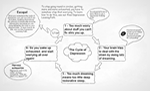
- Both 1 and 2 increase rumination. Going back over past hurts causes more emotional arousal and gives you more to worry about not less. You know from the Cycle of Depression why this would worsen matters.
- The counselor using this type of approach is often trained to give little or no direction to the client. This is counter to treatment guidelines (see introduction above).
- Also from 4, this type of counseling has no fixed time period, and is usually totally passive.
It is not for us to 'discount' psychodynamic or, a related approach, 'person-centred' counseling totally. But it does not work for depression, and we have seen too many people who have suffered from this approach.
Some therapists have been sued for using these approaches in the US when treating depression. Approaches which mainly focus on the past are contraindicated in the treatment of depression and anxiety conditions.
It is becoming more understood that therapy needs to be about equipping people with skills, not trawling through the past.
Why is the 'insight approach' of depression counseling so unsuccessful?
Consider this: If you know why you blush, does the blushing stop?
If you know why you have a flying phobia, does it go away?
Of course not. No research has ever shown this sort insight to be effective in curing emotional problems.
Most people, it seems, know why they have a particular problem - or at least have a good idea - but this conscious understanding rarely seems to stop the unconscious behavior - the feelings.
Interestingly though, real insight into depression, the sort provided by the Depression Learning Path, seems to make a huge difference to people suffering from depression. When our clients understand that they are simply suffering a normal response to excessive levels of emotional introspection, part of the introspection is dealt with - the awful ongoing thought of "What is happening to me?"
So what types of counseling are effective in treating depression?
We'll look now at some effective types of depression counseling and also discuss the core elements in each. This is important as it can help you talk through with your health professional the rationale of any treatment you choose.
So, while the names of therapies may differ, you will know what components depression counseling needs to be effective...
Next article: Overcoming Depression - Counseling and Therapy
- 1 - Diagnosis, Vol. 2 Treatment Aspect. United States Public Health Service Agency.
- Psychotherapy Versus Medication for Depression: Challenging the Conventional Wisdom With Data - David O. Antonuccio and William G. Danton, University of Nevada School of Medicine and Reno Veterans Affairs Medical Center Garland Y. DeNelsky, Cleveland Clinic Foundation
- Dolnick, E. (1998) Madness on the Couch. Simon & Schuster.
About the authors


The Depression Recovery Program
The Cycle of Depression
Understand precisely how depression makes you feel so bad, and what you can do to fight back today.


